Posts

Showing posts with the label medieval Mediterranean

The Umayyad Siege of Constantinople (717-8)
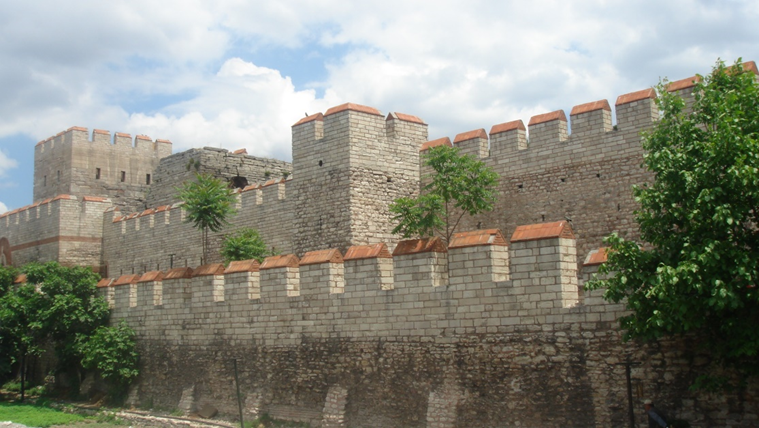
Image
  A restored section of the Theodosian Walls of Constantinople   https://en.wikipedia.org/wiki/Siege_of_Constantinople_(717%E2%80%93718)   I have completed a draft of the first section of a new chapter about the Second Siege of Constantinople, a joint land and naval operation supervised by  Maslama al-Malik, the caliph's brother and an adept general.    Emperor Leo Isaurian did not have a robust fleet to prevent the Arab navy from plying through the Turkish Straits as far as the walls of Constantinople. However, Byzantine engineers equipped their  dromons  with the Greek Fire, the secret weapon whose emotional impact rose over its destructive force. Its initial use pressured the Arab ship to take distance from the walls.   It is unfair to ascribe Byzantine success only to this powerful weapon. The Greeks demonstrated  better tactics and managed to combine their limited means to wade off the aggressor.  It became clear that...

The Employment of Fleets in the Medieval Mediterranean

My interest in the topic encourages me to go even further. Last month I received over 2.8 K views from the readers of my blog: an all-time record.  There is little to report about this week. I completed collecting data about the East Roman fleets, which knew several bouts of boom and bust. I realized that a better option would be to compare the opposing navies, e.g., the Byzantines vs. Arabs, the Normans vs. Byzantines, the Venetians vs. Genoese, and the Venetians vs. Ottomans. Demanding research, but only after finishing it will I be able to decide whether my current chapter makes water.  I am now checking the Norman fleet vs. Byzantium, i.e., the foundation of the Norman fleet in South Italy and Sicily and the Norman invasion of the Balkans. This is a preliminary stage, which will take a lot of time. However, without this basic knowledge, I will have nothing to say about the blue powers' strategy and tactics in the Mediterranean. If I decide to cover the Renaissance, I must ...

The Slender Giants of the Wine-Dark Sea (1)

  I am still undecided about the plan to write a new book. Meanwhile, things are getting into a groove.  Whether a book in its virtue or a unit in a volume, it will be titled "The Anguish and Thrill of Navigation". I may add a subtitle emphasizing that the topic concerns plying the medieval Mediterranean. I have chosen an epigraph from Eustache Deschamps, a 14th- century French poem. His extract claims that landlubbers, no matter how they are proficient in globetrotting have no idea about the hardships of sea travel.  The prototype of the project is based on a string of articles written in 2014-2015 for my second manuscript, "The Enchanting Encounter with the East". However, these papers were excluded from the final draft since the book deals with land travels rather than seafaring. A new, extended version of these essays makes them awkward to use in my third project, which focuses on the Age of Discovery. On the other hand, my current project is too significant to ...

Galleys versus Sailing Ships: Plying the Waters of the Medieval Mediterranean

Image
  Venetian War Galley, late sixteenth century https://www.pinterest.com/pin/511721576383894517/ Genoese Merchant Vessel https://www.pinterest.com/pin/313915036504583191/ The first chapter of a new unit compares and contrasts galleys and sailing ships negotiating maritime routes in the medieval Mediterranean. It discusses shipbuilding approaches and the diet of seafarers. The paper is based on my previous version penned about seven years ago but sustained major corrections. Due to personal reasons, I will keep the draft intact but I cannot help uploading the first page for you.  A curious landlubber gazing at the sea could discern with ease two broad types of watercraft hugging the coast: oared vessels (galleys) and sailing ships. These breeds epitomized the unabated contest between seaworthiness and speed. Oared vessels were born for speed and doomed to fight; not for nothing tags like "dromon" (Greek: "racer") in Byzantium and "sagitta" (Latin: "ar...