Posts

Showing posts from 2023

A Tale of the Two Watercraft Brands

  I'm not ready yet to unveil the outline of my current project titled " The Fright and Thrill of Navigation:  Seafaring in the Medieval and Renaissance Mediterranean,"  but I will disclose a few details. The first part will be "The Age of the Galley." It consists of the intro, A Tale of the Two Watercraft Brands, and two chapters, Early War Galleys and Late War Galleys.  The introduction is ready, at least as a magazine version, and I even uploaded it on the Academia site, not as one but as three articles: https://www.academia.edu/104456432/War_galleys_in_the_Medieval_Mediterranean https://www.academia.edu/107397680/Sailing_Ships_in_the_Medieval_Mediterranean https://www.academia.edu/109918628/Galleys_vs_Sailing_Ships_Comparison_and_Contrast I am currently editing Chapter 1: Early War Galleys, which I divided into portions for possible magazine publication.  I am also assessing the material collected for a new chapter based on the Battle of   Los Form...

Battle of Meloria

Image
 A friend asked me whether I retell the known circumstances in my writing. I find it a tricky issue. Of  course, I base my narrative on familiar descriptions, trying to relate the events in my words. I search for lively expressions to convey the meaning. However, I check the well-known descriptions with the sources, applying logic to estimate the value of both the sources and modern rendering.  I have recently finished writing a new chapter, The Battle of Meloria (August 6, 1284), which pitted the Pisan and Genoese fleets in the view of Porto Pisano.  Before that, the Pisan fleet made an abortive effort to blockade the port of Genoa, taking advantage of the fact that a decent-sized Genoese squadron under Benedetto Zaccaria engaged elsewhere. The Ligurian war council recalled the ships, and Zaccaria entered the harbor unharmed. How could it be when the Pisans surrounded the entrance to the port? Why didn't the Genoese attempt to squeeze the less powerful rival navy an...

The Siege of Chandax (3)

  I have finished writing this chapter. It starts with a small introduction about Byzantine chronicles. I added this section because my narrative primarily draws from these chronicles, and I want   to caution the reader about their credibility. Often penned by monastic historians poorly versed in naval and military matters, they contain hagiographic material or facts biased by the witnesses' viewpoints and political agenda. I also attached the Reassessment, the summing up of my story. As usual, I will keep it on hold. My next chapter will deal with the Battle of Meloria, August 1284, which pitted the Pisan and Genoese fleets off Porto Pisano. Like the Battle of Chandax, it was a decisive confrontation that put an end to the naval domination of the City on the Arno. It also supplies an excellent  example of the encirclement of  hostile forces, worth discussing in military academies. I also received an OK from the Institute of  Integration coordinator for a s...

The Siege of Chandax (2)

  I spent some time collecting and evaluating material for my new topic.  Last week, I started writing a first draft. I offer you its template (unfinished): a. The Importance of Crete (on the geopolitical map) b.  The Emirate of Crete (as the Muslim polity, ca. 824-961) c. The Preparations for the Campaign (the energetic chief minister, the young emperor, and the head of the expedition) d. The Voyage (we do not have the entire itinerary but only some stopovers) e. The Landfall (The armada anchors at Crete, and Nikephoros Phokas conducts the pitched battle on the beach) f. Setting the Military Camp (Pitching the siege camp in the view of Chandax. The Byzantine practice of setting up camps) g. The Siege (The failure of the direct assault, the drawn-out confrontation, an attempt to starve out the besieged) h. Guerilla Operations (The elimination of a Byzantine detachment and Phocas' revenge on Cretan partisans) i. The Winter (The weather hardships fortified by running out of...

The Siege of Chandax

Image
  My new chapter is called "The Siege of Chandax." This city, the capital of the Emirate of Crete (c. 924-961), was under siege by the Byzantine army between July 960 and March 961. Despite the numerical advantage, it took the general Nikephoros Phokas over seven months to take over the fortified location.  It was a great victory since Crete, the erstwhile Roman enclave, was under Muslim domination for nearly 140 years. The island lay at the crossroads of routes connecting Greece, Anatolia, Cyprus, the Levant, and Egypt, i.e., the eastern Mediterranean. The Cretan navy endangered trade lanes in the Aegean, took control of several islands, and ravaged the mainland.  The Emirate was a wealthy polity and a convenient way station for Egyptian and Syrian fleets poised against the East Roman Empire.  There are many blank spots about Muslim Crete and the Byzantine recovery. I am trying to scramble through Byzantine and Arab sources to scribble a readable and trustworthy sto...

The Portage of Ships across the Isthmus

  I will devote this chapter to t he Byzantine admiral, Niketas Ooryphas's  indigenous decision  to transfer his dromons along the long-forgotten land route across the Isthmus of Corinth. He did this unusual deed to catch his opponent, Photios, the admiral of the Cretan Muslim fleet, off guard. I picked up this character because I want to show the tactical depth of medieval naval commanders.  This chapter belongs to Unit II of my project,  The Intricacies of Naval Warfare. Up until now, it has included four chapters:       1.   Naval Factories, where I describe medieval naval bases.          2.  The Battle of Ad Decimum. The collision of the Byzantine Empire with the Vandals, without a maritime battle but with the participation of the East Roman fleet, where we, for the first time, discern the use of dromons.         3.  The Omayyad Siege of Constantinople (August 717...

The Intricacies of Naval Warfare (1)

 The new trend is taking shape. The material is so vast that the title, "The Intricacies of Naval Warfare," will cover the entire book unit instead of individual chapters. The content will spread via the sixth-fourteenth centuries and include the main battles viewed through their strategy and tactics. As an epithet, I chose the following extract from Thucydides:  “Sea power is a matter of skill; it is not possible to get practice in the odd moment when the chance occurs, but it is a full-time occupation leaving no moment for other things.” I had another look at Chapter 1, Naval Factories, and made minor corrections to this solid piece describing how shipyards looked like, which facilities they encompassed, and which workers they engaged.  Chapter 2, The Battle of Ad Decimum (September 13, 533), is a land battle that pitted the Byzantine army commanded by General Belisarius against the Vandal army headed by King Gelimer. I stopped on this episode as it required the fleet's...

The Umayyad Siege of Constantinople (717-8)

Image
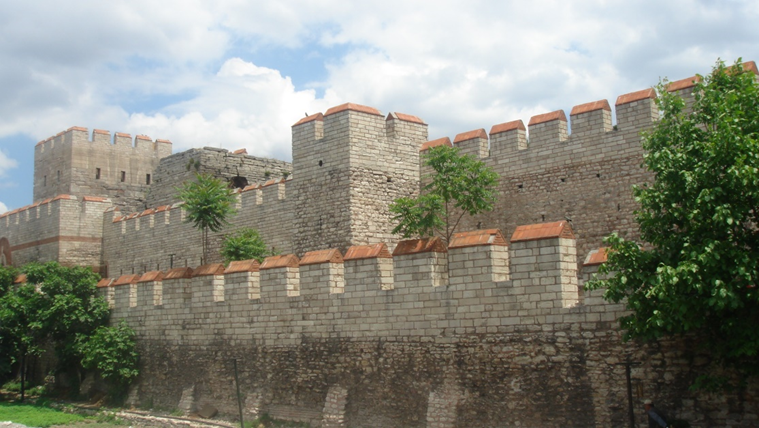
  A restored section of the Theodosian Walls of Constantinople   https://en.wikipedia.org/wiki/Siege_of_Constantinople_(717%E2%80%93718)   I have completed a draft of the first section of a new chapter about the Second Siege of Constantinople, a joint land and naval operation supervised by  Maslama al-Malik, the caliph's brother and an adept general.    Emperor Leo Isaurian did not have a robust fleet to prevent the Arab navy from plying through the Turkish Straits as far as the walls of Constantinople. However, Byzantine engineers equipped their  dromons  with the Greek Fire, the secret weapon whose emotional impact rose over its destructive force. Its initial use pressured the Arab ship to take distance from the walls.   It is unfair to ascribe Byzantine success only to this powerful weapon. The Greeks demonstrated  better tactics and managed to combine their limited means to wade off the aggressor.  It became clear that...

The Employment of Fleets in the Medieval Mediterranean

My interest in the topic encourages me to go even further. Last month I received over 2.8 K views from the readers of my blog: an all-time record.  There is little to report about this week. I completed collecting data about the East Roman fleets, which knew several bouts of boom and bust. I realized that a better option would be to compare the opposing navies, e.g., the Byzantines vs. Arabs, the Normans vs. Byzantines, the Venetians vs. Genoese, and the Venetians vs. Ottomans. Demanding research, but only after finishing it will I be able to decide whether my current chapter makes water.  I am now checking the Norman fleet vs. Byzantium, i.e., the foundation of the Norman fleet in South Italy and Sicily and the Norman invasion of the Balkans. This is a preliminary stage, which will take a lot of time. However, without this basic knowledge, I will have nothing to say about the blue powers' strategy and tactics in the Mediterranean. If I decide to cover the Renaissance, I must ...

Intricacies of Naval Warfare

 This title of a new chapter, in which I will elaborate on naval arsenals and the employment of fleets, is still in diapers. I wrote an extract about the former and began checking the material about the latter.  I realized that speaking about Mediterranean fleets needs to be more professional. Instead of referring to all naval activities at one blow, I must consider the Byzantine, Arab, Norman, Venetian, Genoese, Catalan/Spanish, and Ottoman navies. Until now, I evaluated the data about the Byzantine navy and began developing what I dub "bits & pieces." I transferred some of these "odds and ends" to the first two chapters: "A Tale of the Two Watercraft Brands" and "Early War Galleys."  I want to analyze the strategy of leading fleets and what tactics their admirals chose to implement the task instead of describing concrete battles.  I will give you a few snapshots of my studies--the first concerns Byzantine horse transports, i.e., cargo galle...

Galleys in the Medieval Mediterranean

Image
  Grazioso Benincasa. Detail from a 1482 nautical chart depicting a galley and a Portuguese caravel https://www.meisterdrucke.ie/fine-art-prints/Grazioso-Benincasa/1101817/Galley-and-Portuguese-caravel,-detail-from-the-Nautical-chart-of-the-Mediterranean.html My second project is over. All 29 papers have been uploaded and offered for discussion. I have realized my potential, acquiring more than 10 K readers. Even my previous projects: "Dawn and Sunset" and an unfinished African project, receive moderate interest.  It is time to start uploading articles from my current project, dubbed "The Fear and Thrill of Navigation." I decided to present it not by chapters but by lumps. The apparent reason is to ramp up my readership. In addition, not all parts are ready, and I may need to revise them before uploading. I continue to research war galleys and sharpen my understanding of various issues.  I have to delay even this plan.  I sent the first extract, "Galleys in ...

Encouraging News

 I want to share a bunch of encouraging news with you.  Since August 2019, I have been building my readership community on Academia.edu, a site for researchers. View https://independent.academia.edu/BaizermanMichael  I uploaded eight chapters from my first book, "Dawn and Sunset: A Tale of the Earliest Cities in the Near East." I started transferring the units from my second boon, "The Enchanting Encounter with the East." It was a slow start. By the end of my first year, I had about 1K views.  At this stage, Academia.edu ushered in a new rubric, Discussion. After sending a paper to publication, an author can discuss his report. It usually takes three weeks, with an option for an extension. You write an invitation, and the site sends it to around 1 K people in addition to your fans. I resolved to put my articles to the test. Suddenly, many people recognized my name and became familiar with my studies. One can encounter researchers, students, and graduates of many uni...

The Latecomer's Update

  My Internet was mute for nearly a month and only now I begin to recover from this unpleasant experience. This is what I did in a few past days: I uploaded my article, John of Plano Carpini, for Discussion.  https://www.academia.edu/92846942/John_of_Plano_Carpini This is a chapter from the last unit of my book, "The Enchanting Encounter with the East." I was delighted to learn that I have got 9,500 views. I am nearing my current goal of 10 K.  I have edited a chapter from my third project,  The Fright and Thrill of Navigation:  Seafaring in the Medieval and the Renaissance Mediterranea n . The paper is titled "Early Light Galleys" and has the following outline: a: LBR dimensions [length to beam ratio] b: functions of galleys c: Sailing season   d: nocturnal voyage e: Operational range f: Speed and watering of the crews g: Coastal shipping and beaching h: Shipworm and Life Expectancy i: Visibility j: Seaworthiness k: Byzantine innovations l: Latin achieveme...

Prelude: A Tale of Two Watercraft Brands

 The introduction to my third project, "The Fright and Frill of Navigation," focuses on the main topic of discourse: the two watercraft brands plying the waters of the medieval and renaissance Mediterranean. It is impossible to start covering the subject without preliminary notes about similarities and distinctions between the galley and the round ship.  My introduction embraces three aspects--the galley, the round ship, comparing and contrast--and ends with the reappraisal, reinforcing the primary outcomes. Since I am still waiting to be ready to upload the paper on my website yet (see my website https://independent.academia.edu/BaizermanMichael), I will present its outline.  A: The Galley a. The two brands b. The galley’s performance c. Low freeboard d. Propulsion e. Choppy seas f. Hugging the coast g. Wintering h. Provisioning B: The Round Ship a.        Propulsion b.        Lack of wind c.   ...

John of Montecorvino

  I have received good news from Academia. After over two months' delay, I finally got access to Discussion. The confirmation coincided with presenting my last chapter, John of Montecorvino, to the public. https://www.academia.edu/96931204/John_of_Montecorvino The paper has triggered replies and enjoyed more than 150 views. I am on the way to realizing my potential in Academia, which will stand around 10 K views. I still have two more chapters for Discussion. I noticed some readers come across my previous papers, from the second to the first book. It is very encouraging. I am beginning to form a community of readers, primarily academics. I wish I also had more readers from the general public since this is my target audience.  My zoom lecture in the historical-philosophic club about Alexander against Gog-Magog: Part 2 was  successful. I received many compliments and questions. Some listeners wished they had been present at the previous lecture, and I invited them to p...

February 2023 Update

  I still need help with updating articles for Discussions on my Academia page. The support team says  this is a huge issue for their engineering gang to tackle. They have been doing it for almost two months. My exposure to a wider audience went down, though I already have over 9 K views. My last contribution is chapter 28, William of Rubruck, of my second book, "The Enchanting Encounter with the East." https://www.academia.edu/96081693/William_of_Rubruck I will upload my last chapter in about two weeks and attach a content page.  I agreed on a new zoom lecture based on Unit IV of my book. Part 2 of the cycle covers the legend of the Iron Gates, proverbially constructed by Alexander of Macedon to repel invaders from beyond the Caucasus. I will elaborate on steppe pastoralists and explain how medieval literati replaced unknown tribes with the familiar horrifying image of Gog-Magog.  I continue collecting and developing extracts for the third chapter of my project...

Light Galleys (5)

 As you probably know, I continue developing the second chapter about war galleys.  The updated book outline looks as such: Introduction: The Galley vs. the Round Ship. The first draft is ready, with many additions waiting for their turn. Unit I: Light Galleys Chapter 1: Early War Galleys. The first draft is ready, with many additions waiting for their turn. Chapter 2: Later War Galleys, is in process. The initial plan should include four parts: a. The Monster Galley: Vettor Fausto's Quinquereme.  b. Rowing a scaloccio c. "Galley Slaves" d. Gallea alla pontina The first two parts are ready, the third needs rearrangement, and the fourth requires additional research. Besides, I may add data about maximum displacement, dimensions, sailing season, water supply, and purpose-built galleys.  Common knowledge asserts that war galleys were relevant until the Battle of Lepanto (1571), giving way to galleasses and ships of the line (sailing ships). During my research, I learned...