Posts

Showing posts from 2022

John of Plano Carpini

Image
  I continue uploading chapters from my second book, "The Enchanting Encounter with the East," on Academia. The latest contribution is John of Plano Carpini. https://www.academia.edu/92996408/John_of_Plano_Carpini_docx The paper follows the traces of one of the first European medieval travelers to the Far East. The Franciscan monk returned, having endured painful hardships, to tell a fascinating story about the Mongols' habits and mores. He also provided food for thought for the imminent threat of a military assault against Western Europe and advocated for European mutual security. Tags: John of Plano Carpini, Pope Innocent, Great Khan Guyuk. My work on the third project, "The Fright and Thrill of Navigation," is in full swing. I have recently finished updating the drafts of the two initial chapters, The Galley vs. the Round Ship and The Early Light Galleys.  The outline of Chapter 1 remained more or less the same, comprising six parts:  The Galley ( Landlubber,...

Barefooted Envoys

 I uploaded a new chapter of my book, "The Enchanting Encounters with the East." This paper is the first part of Unit VI, The Witness in the Den. It focuses on the Catholic missions to the Far East launched during the 13th and 14th centuries. These enterprises took advantage of the new world order initiated by the Mongols. View https://independent.academia.edu/BaizermanMichael The article is available for Discussions during the nearest three weeks. You may address your remarks to my email address mikebis@yandex.com later.  The paper has received a welcoming response from Avital Heyman, an art historian and an expert in medieval visual culture.  I have made considerable progress with the draft paper on light galleys, covering Byzantine innovations,  Latin achievements, Medieval Triremes & Centerline Rudder, Horse transports, and Purpose-built galleys. The last topic left is  Displacement & Maintenance. If I don't find interesting data, I will drop it...

Light Galleys (4)

 I have made good progress on Chapter 2. covering many issues, such as s peed and watering of the crews, coastal shipping and beaching, s hipworm and life expectancy, v isibility, and s eaworthiness.  I am currently checking the section dealing with Byzantine  innovations: full deck, dromons, and galea. Though I filtered the data from my previous search, I resolved to look for more info. The chapter  comprises 13 pages (about 5 K words) and will probably be much longer. I would like to add a section of transport galleys carrying supplies and horses.  I have requested and received John E. Dotson's article, " Safety Regulations for galleys in mid-fourteenth century Genoa: Some thoughts on medieval risk management." The report was unavailable in my search engine, and I asked the author to send me a copy. John is the emeritus professor at Southern Illinois University. He agreed to answer my questions, and for the first time, I have a correspondent who studies the s...

Light Galleys (3)

  I have made a plan of the current chapter with a working title, Light Galleys, to ease the development. It includes 16 or 17 topics and each of them needs an extra brief research. I have already covered a few items:  LBR dimensions [length-to-beam ratio of the hull] Functions of galleys Sailing season Nocturnal voyage Operational range Speed and watering of the crews     The scope of the narrative becomes enormous. I wrote 6 pages and covered about a third of the thematic list. However, now I work with confidence, realizing that I know the storyline and guess how I can narrate it. This is the key to the creative activity.   I am ready to correct some misconceptions, even expressed by the leading scholars and primary sources. For example, medieval warships couldn't ram their rivals or galleys could  confront large round ships. I don't pledge to be original for the sake of originality. In many cases I a gree with the leading experts after I g...

The Underdog and the Power Strife on the Steppes

The paper completes Prester John's saga. The echo of the power strife on the steppes reaches West European intellectuals, who remake it in the contest between the overwhelming Christian overlord and a budding pagan rival. The underdog wins this geopolitical game to become the ruler of Asia while his adversary demises. I also added the Bottom Line and the Notes to the whole unit.  The article is available at  https://www.academia.edu/89214577/The_Underdog_and_the_Power_Strife_on_the_Steppes  and is open for discussion, in which you are welcome to participate. Interestingly, that after uploading this work on the Academia site, I gained a fan, The International Institute for the Study of the Nomadic Civilizations of UNESCO.  I presented my interpretation of Prester John's saga in Unit V of my book, "The Enchanting Encounter with the East," published in 2022 by Authorhouse and in eight papers on my Academia site.   I intend to continue uploading the r...

Light galleys (2)

  I  assessed the material and transformed all Bits & Pieces into one file. I labeled all the scraps and wrote a list of labels to make them functional.  Despite many distractions, I continued developing the storyline about the light galleys. I started sowing my Bits and Pieces together to make long sheets. Indeed, there are so many topics that they will cover the whole chapter or even two chapters. The main themes, as I see them now, are:  the galley layout,  the function of the fleets,  naval bases,  the  geopolitics of blue-water powers.     My latest reading on the subject is  Matthew King, The Norman Kingdom of Africa and the Medieval Mediterranean. (THE UNIVERSITY OF MINNESOTA, 2018). This dissertation has enriched my  understanding of the geopolitical vision of the kingdom of Sicily, especially Roger II, who expanded his territory to include south Italy and Ifriqiya, a coastal strip in North Africa. He aimed to ...

Light Galleys (1)

  The following is an update of my work on a new chapter.  Due to all sorts of distractions, I continue assessing the data on light galleys. The good news is that I will finish the evaluation soon. I skip the material concerning other matters and concentrate all my findings in a single file for further consideration. I also decided to make an exclusive vocabulary in this chapter to facilitate possible corrections.  I still have reservations about the scope of the material. Most of the things I collect cite the same facts in a new manner. I will decide later which version is preferable or will make a mix. I may save some of these repetitions for the concluding section of my paper. I will also reduce citations. Sometimes, I can paraphrase the idea since the original one is not so bright (at least, in English translation). In other cases, I will look for an original citation instead of citing secondary sources.  At this stage, I also check the value of some facts. For e...

Light Galleys

 I began to estimate the collected material on light galleys, the ultimate warships of the medieval Mediterranean. In truth, many articles I picked concern other subjects, and I will retain them for the future. There are a lot of corrections and additional notes; some of them refer to Chapter 1. The previous chapter studies the main differences between galleys and round ships. While reading each file, I write "bits and pieces," even on familiar topics. That allows me to reconsider some paragraphs and add valuable data. I watch the growth of additional branches of the main issue and sometimes research them to realize if I can propose new developments to my storyline.   I am a little worried about the scope of my project. Chapter 1, designed as an introduction, grew very large, whereas Chapter 2 appears to be enormous. I wonder what I will do with this monster to make it readable. I can relentlessly cut the material, though I will lose essential facts.  I hope that I w...

Appeared in Print

  My second book, "The Enchanting Encounter with the East," has appeared in print and was published by AuthorHouse UK. I feel elevated and relieved. I hope I have improved the content through careful editorship, and my readers will enjoy traveling across the pages. My book is set in the European Middle Ages, and its main characters are Latin scholars who had imagined the lands and people of the Far East long before they set off to visit them.  There are four main topics that I focused on while writing. The first one is geography: how come that geography being of trivial importance for Latin academics, had gained traction and invited travel?  The second one is history. Who were the horrible Tartars who had nearly conquered western Europe in 1241-1242, where did they spring up, and what would they do next?  The third one is mythology. I picked up two medieval legends: Alexander Barrier and Prester John. I researched the development of these tall tales and showed how th...

The Mysterious Letter

I have just started a discussion on my latest paper  https://www.academia.edu/82514995/The_Mysterious_Letter This chapter from my book, "The Enchanting Encounter with the East," continues the exploration of the popular character (Prester John) and his impact on multiple fans worldwide. I invite you to take part in the debates.  In the abstract, I wrote: " The mysterious letter penned by the elusive potentate, Prester John, became the talk of several European royal courts. The writer invited heads of state to visit his fascinating country abounding with marvels and wonders. The audience was divided between enchantment and skepticism, leaving nobody lukewarm".  Meanwhile, I devoted much time to developing my current topic: the evolution of war galleys in the medieval and renaissance Mediterranean. I think I have found a reference point, the Byzantine fleet, especially its ebb and flow between the sixth and the eleventh centuries.    The rise of the Italian fleets...

The Slender Giants of the Wine-Dark Sea

Image
  A model of a sixteenth-century Maltese galley https://en.wikipedia.org/wiki/Galley  This is the title of the second chapter of my new manuscript. To put it simply, it is about war galleys in the Mediterranean. I have entered the stage of assessing and developing data. It will take a long time, and I will probably write several blog entries concerning this topic. Why does it take so long? The chapter will have at least four divisions: light galleys, the monster galley, the intricacies of naval warfare, and the shipborne artillery. For each section, I need to read the collected data, decide on its relevance, and write what I call "scraps," i.e., a memorable phrase, sentence, or a paragraph attached to that piece of info. I also need to check the details. For example, one source says that Ottoman shipwrights produced inferior galleys because they used "green" timber (unseasoned wood). An extraordinary claim that may need an additional quest. What was wrong with the O...

Galley Proof Revisited (1)

The galley proof reviewing is over.   Arduous work, I must tell, that squeezes the brain almost to the boiling point. There are some last-minute changes that I want to include. I also reviewed 44 illustrations and changed those not in the public domain. I got several permissions, but it was not easy. Not everybody replied to my letters; sometimes, the correspondents wanted money for their consent.  Meanwhile, I uploaded another chapter, The Shadow Crusader: Otto of Freising.  https://www.academia.edu/79701738/The_Shadow_Crusader_Otto_of_Freising The advent of Prester John in official history, with a German chronicler Otto von Freising acting as the ruler's "godfather." The chapter describes the contradicting nature of the literary character. My audience has grown to 7 K readers, and when I complete uploading the remaining chapters from my second book, it may reach 8 K. These good tidings prompted me to continue my quest for a literary agent. I need a mediator who can...

Galley Proof Revisited

  My publishing coordinator asked me to arrange another round of galley proof. That gives me a chance to place last-minute corrections. Rereading the text provides a fresh outlook and reveals issues that might not be clear to the general public. My luck is that I use the editor program Grammarly which exposes any unclear sentence, phrase, or even a rare word that might confuse the reader.  Meanwhile, I will continue to upload new chapters from the second book on my academia site:  https://independent.academia.edu/BaizermanMichael Some readers view the chapters from my first book, "The Dawn and Sunset." I think I can upload these chapters, too, though it has to wait till the following year. Each Discussion session lasts three weeks, and I don't need to hurry up. I believe that I can reach the ceiling of 10 K readers, though it might take a year or more.  Editing the text is a headache, and I give myself time to complete my self-education. I continue reading "Trade, Pi...

The Galley Proof is Over

  After a month's work, I wrote over 120 pages of remarks on the galley proof. I am not sure that my editor will be delighted, but I am happy. The changes I have made became possible due to Grammarly, a particular editorship program, which continues to stun me with its remarkable qualities. I especially like entangled issues when the program suggests splitting the text into more palatable sentences or avoiding the monotony of three successive simple sentences. It does not show how, making the task challenging and exciting.  I am currently collecting data for my new project, with the working title " The Fright and Thrill of Navigation:  Seafaring in the Medieval and the Renaissance Mediterranean."    I pick up facts and figures about war galleys, their types, and the armament. I found a fascinating book about the Byzantine navy, "The Age of the Dromon," penned by J.H. Pryor and E.M. Jeffreys. This warship was the stepping stone in developing the West Europea...

The Galley Proof of My Second Book

  Since the end of March, I have been making progress with my galley proof for "The Enchanting Encounter with the East."  Before making corrections, I checked each unit using my new editorial program. I redesigned many paragraphs, and the list of amendments has topped 70 pages after finishing four units out of six. I imagine my editor will be discontented.  Next week, I will re-edit Unit V, which is the story of Prester John, and if all goes well, I will complete my task by the end of April.  Listeners liked my lecture    "The Saga about Humankind: the View on the Habitable World during the European Middle Ages and the Renaissance." Some of them asked where they could read the book. I directed them to my Academia page,  where they read 18 chapters of my second book (out of 29). The rest I will upload throughout this year.  I will continue to collaborate with the Institute of Integration concerning future lectures.  https://independent.academi...

My Second Book

 I have just received the galley proof of my book, "The Enchanting Encounter with the East." Yes, I can call it now a book rather than a manuscript.  Checking the galleys is a long and tedious process, but it also has fascinating sides. First of all, my publishing team of Authorhouse UK has done a fantastic job improving the text. I appreciate hearing my voice slightly different and retaining all its significant points.  Secondly, I am using the editorial program of Grammarly, a mandatory lifeline thrown to writers, to raise my standards and to revise the work of the publishing gang. The bottom line: my text has become much more readable and eloquent.  While working with Grammarly, I like those moments when the program advises to rewrite the sentence, giving only general recommendations. I have to try various versions and, if I succeed, I feel so tired and happy as if I have run long distances!  My book will have references to illustrations instead of artwork. I...

The Turks in Jacob's Tents

Image
I have just uploaded the final chapter of the cycle of articles focused on the legend of the Iron Gates. This collection of papers make up Unit IV,  Mapping Marvels and Monsters: In the Shadow of the Iron Gate, of my book "The Enchanting Encounter with the East."    The following extract tells the story of the Khazars, the tribe confederation of the steppe Turks, as it is exposed by written sources and archaeological finds. You can view it on my Academia page  https://www.academia.edu/74005169/The_Turks_in_Jacobs_Tents I have also forwarded this piece to the Discussions. I want to see the comments on the role of the Khazars as a "wall" hampering the expansion of the Arab Caliphate into the Pontic-Caspian steppes and the Byzantine Empire in Crimea. The following story adds to the myth of Gog-Magog that loomed large on Latin Christendom throughout the Late Middle Ages.  The map of the Khazar Khaganate between 650 and 850 https://en.wikipedia.org/wiki/Khazars ...

The Galley versus the Round Ship (2)

Image
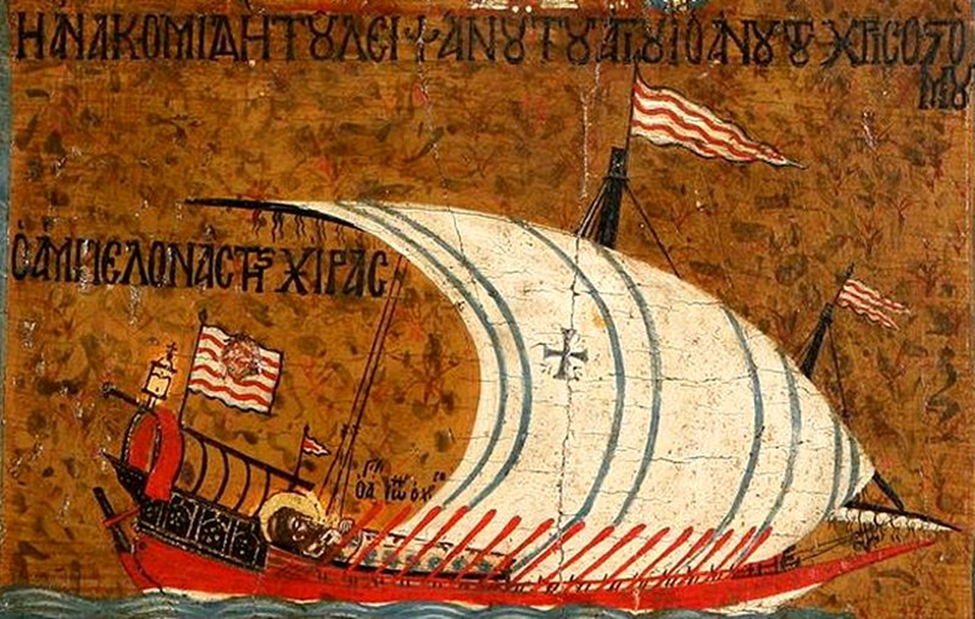
 Chapter 1 of my third manuscript, " The Fright and Thrill of Navigation:  Seafaring in the Medieval and the Renaissance Mediterranean", is over. At least, its the first draft. I have erased most of the obvious errors with the aid of Grammarly. I am considering hiring its Premium version to become a better writer.  This chapter compares and contrasts the two medieval and renaissance watercraft types in the Mediterranean considering their functions, navigation, and more. I also added about 60 notes and two illustrations:   The first is a  fourteenth-century lateen-rigged Byzantine galley, whereas the second is  a ninth-century Byzantine ship sporting a settee sail.  The paper needs time to "dry up". It might endure some further corrections and require a fresh look. Meanwhile, I have started collecting material for the second chapter. It will focus on warships and comprise several parts. For example, the development of gunpowder ordnance on board. 

The Galleys vs. the Round Ship (1)

 T he maiden chapter of a new project is nearly over. I will carry out the content editing at a later stage. Yet, I need to review the vocabulary section created for the extract to fish for novel ideas.  The chapter gives a general idea of medieval shipping in the Mediterranean by depicting two broad types of watercraft. Even at this initial stage, I make use of contemporary travelogues written mostly by landlubbers. Besides galleys and round ships, I will speak about the main developments in the construction of ships and the sailors' diet.  In the coming week, I am planning to revise an old article, The Ten Tribes and Other Monsters, from Unit IV of my second project, "The Enchanting Encounter with the East". Authorhouse UK is preparing this manuscript for publication. I wrote a few more letters asking for reusing of photos as book illustrations but meanwhile received only three positive replies. I hope that in some other cases the images do not require copyright permiss...

The Enchanting Encounter with the East: the book cover

 The artist sent me his proposal for the book cover. Though I cannot copy it, I will give you the general idea. There are two photos: a man climbing a steep mountain slope and another one walking along a suspension bridge. Both shots are taken in the backdrop of a "wild" environment.   I continue to write letters to the owners of the images asking for permission to use them as the book illustrations. Until now, I have received three of them: from the British Library for the Psalter Mappa Mundi, from the University of Glasgow Library for an image from  Vox Clamantis of John Gower, and from the  Antiquarian Booksellers Association of America for  Henrich Bunting's map of the world as a cloverleaf.  In several cases, I was unable to find the owner. I still don't quite understand the meaning of these inquiries that I had to write at the insistence of the publishing house. In most cases, the copyright expires after 70 years. All my images have far exceeded ...

The Enchanting Encounter with the East: A New Book

  Authorhouse UK, the self-publishing company that printed my first book, "Dawn and Sunset: A Tale of the Oldest Cities in the Near East", has offered to issue my second volume. Heaven knows, I did a lot to avoid this chance. Meanwhile, I have found no traditional publisher that is enthusiastic about bringing out my composition. Since I had no alternative, I finally agreed.  I did my best, revising the entire text again. I added several images though I am not sure that they will accompany the text. My literary consultant said that I need to ask permission from the owners of the photos even though most of my artwork is borrowed from  Wikipedia. I wrote several letters but received only one permission, from the British Library concerning the Psalter Mappa Mundi, where Jesus blesses the earth.  In the following weeks, you will catch a glimpse of my second book. It is titled, " The Enchanting Encounter with the East: Breaking the Ice between the Latin West and the F...

The Lost and Found Tribes

Image
  Image: A Typical Notice https://www.juliemeek.com.au/lost-and-found/ The next chapter of my second manuscript is titled "The Lost and Found Tribes". It belongs to Unit IV:  Mapping Marvels and Monsters: In the Shadow of the Iron Gate, and focuses on the legend of the Ten Lost Tribes.    The demise of ancient Israel and the mass deportation of its population set the background of the legend about the Ten Lost Tribes. The Samaritan community has been estranged from Judaism, although many believed that one day the vanished people would rise from the dead. Medieval Jewish philosophy places the refugees in the far-off land beyond reach and makes them a consolidated community governed by the Jewish Law and under the sway of a Jewish prince. This congregation is poised for the coming of the Messiah to lead it to the Promised Land.   The article is available at the Academia site:  https://www.academia.edu/69800164/The_Lost_and_Found_Tribes  As usual, it is...