Friday, August 25, 2023

The Intricacies of Naval Warfare (1)

 The new trend is taking shape. The material is so vast that the title, "The Intricacies of Naval Warfare," will cover the entire book unit instead of individual chapters. The content will spread via the sixth-fourteenth centuries and include the main battles viewed through their strategy and tactics. As an epithet, I chose the following extract from Thucydides: “Sea power is a matter of skill; it is not possible to get practice in the odd moment when the chance occurs, but it is a full-time occupation leaving no moment for other things.”

I had another look at Chapter 1, Naval Factories, and made minor corrections to this solid piece describing how shipyards looked like, which facilities they encompassed, and which workers they engaged. 

Chapter 2, The Battle of Ad Decimum (September 13, 533), is a land battle that pitted the Byzantine army commanded by General Belisarius against the Vandal army headed by King Gelimer. I stopped on this episode as it required the fleet's transportation from Constantinople to Carthage and the first appearance of the powerful East Roman fleet (I mean, warships and not only merchantmen carrying troops and ammunition). Currently, I arrange my bits and pieces for a compelling narrative. 

Chapter 3, The Omayyad Siege of Constantinople (August 717-August 718), is ready. 

Other chapters will include the battles of Corfu, Maloria, Malta, and Acre. I give no details because I have yet to study these combats profoundly. I will decide on the Battle of Corinth, whose main episode was the portage of ships across the Isthmus of Corinth, check other contributions of Roger of Lauria, except the classical Battle of Malta, and delve into episodes of Genoese-Venetian Wars, other than the Battle of Acre. 

Meanwhile, the first extract of the future project is available. 

https://www.academia.edu/104456432/War_galleys_in_the_Medieval_Mediterranean 

I plan to upload the second piece later in the year. 

Thursday, August 3, 2023

The Umayyad Siege of Constantinople (717-8)


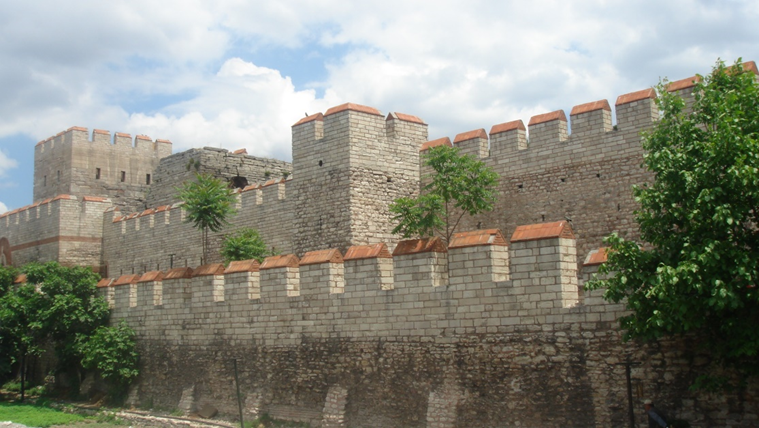
A restored section of the Theodosian Walls of Constantinople 

https://en.wikipedia.org/wiki/Siege_of_Constantinople_(717%E2%80%93718) 


I have completed a draft of the first section of a new chapter about the Second Siege of Constantinople, a joint land and naval operation supervised by Maslama al-Malik, the caliph's brother and an adept general. 

  Emperor Leo Isaurian did not have a robust fleet to prevent the Arab navy from plying through the Turkish Straits as far as the walls of Constantinople. However, Byzantine engineers equipped their dromons with the Greek Fire, the secret weapon whose emotional impact rose over its destructive force. Its initial use pressured the Arab ship to take distance from the walls.  

It is unfair to ascribe Byzantine success only to this powerful weapon. The Greeks demonstrated  better tactics and managed to combine their limited means to wade off the aggressor. 

It became clear that the key to the successful siege of the Imperial City was naval support, and the Greeks had to do their best to bar access to the Marmara Sea from the Dardanelles to foreign navies.  

---------------------------

I made a new draft of the second section of Chapter I, titled "Sailing Ships in the Medieval Mediterranean." 

Before uploading it on my Academia page, I want to offer it to history magazines or online editions. They usually demand exclusive publication.

https://independent.academia.edu/BaizermanMichael  

The article delves into the world of the so-called round ships, which primarily served as freighters, even when pressed into service as part of the fleet.

I comment on sailing ships’ propulsion and behavior in flat calms and storms.  I speak about choosing appropriate sailing styles and debunk the myth of the “closed sea.” 

The article numbers about 3000 words, including endnotes.

-------------------------------

 I collected data for the second section of a chapter about naval tactics: the Battle of Corfu (November 1084) between the Norman and Venetian fleets. Though I am sure about the Battle of Meloria (August 1284) and Malta (June 1283), I am still trying to decide on further chunks.


Thursday, July 13, 2023

The Employment of Fleets in the Medieval Mediterranean

My interest in the topic encourages me to go even further. Last month I received over 2.8 K views from the readers of my blog: an all-time record. 

There is little to report about this week. I completed collecting data about the East Roman fleets, which knew several bouts of boom and bust. I realized that a better option would be to compare the opposing navies, e.g., the Byzantines vs. Arabs, the Normans vs. Byzantines, the Venetians vs. Genoese, and the Venetians vs. Ottomans. Demanding research, but only after finishing it will I be able to decide whether my current chapter makes water. 

I am now checking the Norman fleet vs. Byzantium, i.e., the foundation of the Norman fleet in South Italy and Sicily and the Norman invasion of the Balkans. This is a preliminary stage, which will take a lot of time. However, without this basic knowledge, I will have nothing to say about the blue powers' strategy and tactics in the Mediterranean. If I decide to cover the Renaissance, I must add a section about the confrontation between the Ottomans and the Spanish. The newly discovered data may change my conclusions in previous chapters about the development of war galleys.

I have uploaded a new paper 

https://www.academia.edu/104456432/War_galleys_in_the_Medieval_Mediterranean

This is the initial part of the first chapter of the new project on shipping in the medieval and renaissance Mediterranean. The article delves into galleys as omnipresent warships in the medieval Mediterranean. It analyses their performance, propulsion, sailing mode, and behavior on choppy seas. The paper elaborates on the craft's freeboard, wintering, and provisioning. The concluding section sums up the storyline. I have launched a discussion on this paper so that every reader may join. Unfortunately, Academia disconnected the  notification function of 1 K academics related to this field. 


Saturday, June 24, 2023

Intricacies of Naval Warfare

 This title of a new chapter, in which I will elaborate on naval arsenals and the employment of fleets, is still in diapers. I wrote an extract about the former and began checking the material about the latter. 

I realized that speaking about Mediterranean fleets needs to be more professional. Instead of referring to all naval activities at one blow, I must consider the Byzantine, Arab, Norman, Venetian, Genoese, Catalan/Spanish, and Ottoman navies. Until now, I evaluated the data about the Byzantine navy and began developing what I dub "bits & pieces." I transferred some of these "odds and ends" to the first two chapters: "A Tale of the Two Watercraft Brands" and "Early War Galleys." 

I want to analyze the strategy of leading fleets and what tactics their admirals chose to implement the task instead of describing concrete battles. 

I will give you a few snapshots of my studies--the first concerns Byzantine horse transports, i.e., cargo galleys designed to haul chargers. Some scholars argue about the number of animals. Here is my approach.

A medieval horse with a withers height of 12-14 hands weighed about 550 kilograms and required 36 liters of water daily. The standard weight of 12 horses was 6.5 tons. We must add 430 liters of water, to say nothing about food and equipment. The galley's displacement was 25-30 tons deadweight. 

Since the animals occupied the hold, fifty rowers on the upper bank propelled these transports. The lack of breathing space in the hold allowed the stabling of only horses. Of course, such boats moved slower than dromons, but that was evident, and the commander had to make tough decisions. To send them ahead of the fleet under the convoy of warships or to tow them by galleys to the shore? Like standard galleys, they had a shallow draft and could approach the shore. 

A few words about battle formation: the semicircle order was, first of all, a means of defense. The ships in the deep could afford missile fire,and only the vessels on the ends, usually the strongest ones, could engage in grappling. On the other hand, when the fleet advanced, it could encircle the opponent's navy.

 When the commander split the fleet into lines, friendly ships could replace their wary comrades, reinforce battling vessels, or practice encirclement if the seascape allowed. By the way, admirals, at least in the East Roman fleets, were dignitaries devoid of sea legs and owing their promotion to the emperor's favor or court intrigues.


Friday, May 19, 2023

Galleys in the Medieval Mediterranean


Grazioso Benincasa. Detail from a 1482 nautical chart depicting a galley and a Portuguese caravel

https://www.meisterdrucke.ie/fine-art-prints/Grazioso-Benincasa/1101817/Galley-and-Portuguese-caravel,-detail-from-the-Nautical-chart-of-the-Mediterranean.html


My second project is over. All 29 papers have been uploaded and offered for discussion. I have realized my potential, acquiring more than 10 K readers. Even my previous projects: "Dawn and Sunset" and an unfinished African project, receive moderate interest. 

It is time to start uploading articles from my current project, dubbed "The Fear and Thrill of Navigation."

I decided to present it not by chapters but by lumps. The apparent reason is to ramp up my readership. In addition, not all parts are ready, and I may need to revise them before uploading. I continue to research war galleys and sharpen my understanding of various issues. 

I have to delay even this plan. I sent the first extract, "Galleys in the Medieval Mediterranean," to a few magazines and ,at least in one case, they told me that uploading the text on my site would exclude it from their consideration. I am unsure if they will endorse my writing, but I must respect their opinion. 

This extract is part of the introduction to my third project. It elaborates on the performance of galleys, their low freeboard, propulsion, their behavior in choppy seas, their manner of sailing (hugging the shoreline), wintering, and provisioning. I also attached the reappraisal to summarize  my ideas, notes, and the above illustration. 

Friday, April 28, 2023

Encouraging News

 I want to share a bunch of encouraging news with you. 

Since August 2019, I have been building my readership community on Academia.edu, a site for researchers. View https://independent.academia.edu/BaizermanMichael 

I uploaded eight chapters from my first book, "Dawn and Sunset: A Tale of the Earliest Cities in the Near East." I started transferring the units from my second boon, "The Enchanting Encounter with the East." It was a slow start. By the end of my first year, I had about 1K views. 

At this stage, Academia.edu ushered in a new rubric, Discussion. After sending a paper to publication, an author can discuss his report. It usually takes three weeks, with an option for an extension. You write an invitation, and the site sends it to around 1 K people in addition to your fans. I resolved to put my articles to the test. Suddenly, many people recognized my name and became familiar with my studies. One can encounter researchers, students, and graduates of many universities worldwide. Some readers wrote notes, and I appreciate their efforts, even if I don't agree with some of them, because I received feedback. I forwarded my last paper from my second book for Discussion a short time ago.  View https://www.academia.edu/96081693/William_of_Rubruck

I have already received over 10 K views; my next aim will be 15 K, though it might take several years. Meanwhile, I have finished the draft of Chapter 3: Later War Galleys, in which I will discuss

a.    The Monster galley: Vettor Fausto’s quinquereme

b.    Rowing a scaloccio

c.    “Galley slaves”

d.    Gallea alla ponentina

e.    Dimensions

f.     Functions

g.    Cost

h.    Life span

i.     Sailing off-season

j.     Coastal piloting and speed

k.    Watering the crews  

Rations    

I have  begun to write a new chapter, The Intricacies of  Naval Warfare. I plan to describe naval shipyards and supply bases and check the idea of standing fleets. 

I sent Chapter I to a maritime journal and received an encouraging negative response. The editor acknowledges that I have produced a fascinating and informative piece. Then, he explains why he can't approve it for publication: the article lacks the academic structure. There needs to be a section of existing literature. The writer does not place himself among other authors or offers an argument. 

When I read it, I understood my place. I don't write scientific prose but a story. I don't care about my contribution to the history of research. I give my readers facts and add my opinion. Many people accept this approach. 

Saturday, April 8, 2023

The Latecomer's Update

 My Internet was mute for nearly a month and only now I begin to recover from this unpleasant experience. This is what I did in a few past days:

I uploaded my article, John of Plano Carpini, for Discussion. 

https://www.academia.edu/92846942/John_of_Plano_Carpini

This is a chapter from the last unit of my book, "The Enchanting Encounter with the East." I was delighted to learn that I have got 9,500 views. I am nearing my current goal of 10 K. 

I have edited a chapter from my third project, The Fright and Thrill of Navigation: Seafaring in the Medieval and the Renaissance Mediterranean. The paper is titled "Early Light Galleys" and has the following outline:

a: LBR dimensions [length to beam ratio]

b: functions of galleys

c: Sailing season  

d: nocturnal voyage

e: Operational range

f: Speed and watering of the crews

g: Coastal shipping and beaching

h: Shipworm and Life Expectancy

i: Visibility

j: Seaworthiness

k: Byzantine innovations

l: Latin achievements

m: Medieval Triremes & Centerline Rudder

n: Horse transports

o: Purpose-built galleys 


I am currently collecting data for another chapter about the tactics of naval warfare.