Showing posts with label medieval Mediterranean. Show all posts

Thursday, August 3, 2023

The Umayyad Siege of Constantinople (717-8)


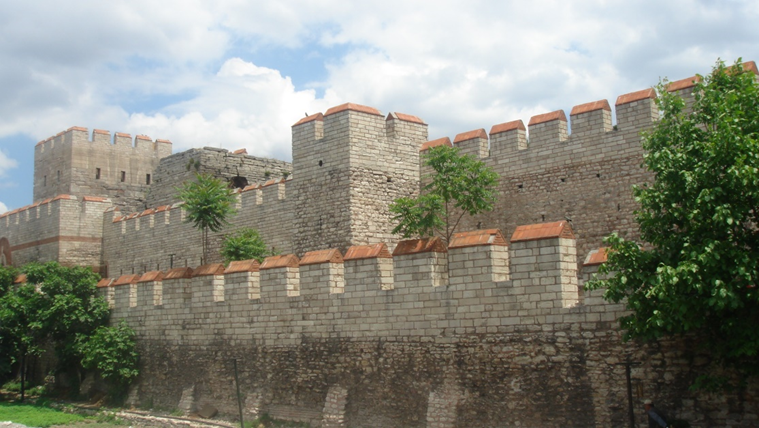
A restored section of the Theodosian Walls of Constantinople 

https://en.wikipedia.org/wiki/Siege_of_Constantinople_(717%E2%80%93718) 


I have completed a draft of the first section of a new chapter about the Second Siege of Constantinople, a joint land and naval operation supervised by Maslama al-Malik, the caliph's brother and an adept general. 

  Emperor Leo Isaurian did not have a robust fleet to prevent the Arab navy from plying through the Turkish Straits as far as the walls of Constantinople. However, Byzantine engineers equipped their dromons with the Greek Fire, the secret weapon whose emotional impact rose over its destructive force. Its initial use pressured the Arab ship to take distance from the walls.  

It is unfair to ascribe Byzantine success only to this powerful weapon. The Greeks demonstrated  better tactics and managed to combine their limited means to wade off the aggressor. 

It became clear that the key to the successful siege of the Imperial City was naval support, and the Greeks had to do their best to bar access to the Marmara Sea from the Dardanelles to foreign navies.  

---------------------------

I made a new draft of the second section of Chapter I, titled "Sailing Ships in the Medieval Mediterranean." 

Before uploading it on my Academia page, I want to offer it to history magazines or online editions. They usually demand exclusive publication.

https://independent.academia.edu/BaizermanMichael  

The article delves into the world of the so-called round ships, which primarily served as freighters, even when pressed into service as part of the fleet.

I comment on sailing ships’ propulsion and behavior in flat calms and storms.  I speak about choosing appropriate sailing styles and debunk the myth of the “closed sea.” 

The article numbers about 3000 words, including endnotes.

-------------------------------

 I collected data for the second section of a chapter about naval tactics: the Battle of Corfu (November 1084) between the Norman and Venetian fleets. Though I am sure about the Battle of Meloria (August 1284) and Malta (June 1283), I am still trying to decide on further chunks.


Thursday, July 13, 2023

The Employment of Fleets in the Medieval Mediterranean

My interest in the topic encourages me to go even further. Last month I received over 2.8 K views from the readers of my blog: an all-time record. 

There is little to report about this week. I completed collecting data about the East Roman fleets, which knew several bouts of boom and bust. I realized that a better option would be to compare the opposing navies, e.g., the Byzantines vs. Arabs, the Normans vs. Byzantines, the Venetians vs. Genoese, and the Venetians vs. Ottomans. Demanding research, but only after finishing it will I be able to decide whether my current chapter makes water. 

I am now checking the Norman fleet vs. Byzantium, i.e., the foundation of the Norman fleet in South Italy and Sicily and the Norman invasion of the Balkans. This is a preliminary stage, which will take a lot of time. However, without this basic knowledge, I will have nothing to say about the blue powers' strategy and tactics in the Mediterranean. If I decide to cover the Renaissance, I must add a section about the confrontation between the Ottomans and the Spanish. The newly discovered data may change my conclusions in previous chapters about the development of war galleys.

I have uploaded a new paper 

https://www.academia.edu/104456432/War_galleys_in_the_Medieval_Mediterranean

This is the initial part of the first chapter of the new project on shipping in the medieval and renaissance Mediterranean. The article delves into galleys as omnipresent warships in the medieval Mediterranean. It analyses their performance, propulsion, sailing mode, and behavior on choppy seas. The paper elaborates on the craft's freeboard, wintering, and provisioning. The concluding section sums up the storyline. I have launched a discussion on this paper so that every reader may join. Unfortunately, Academia disconnected the  notification function of 1 K academics related to this field. 


Saturday, May 29, 2021

The Slender Giants of the Wine-Dark Sea (1)


I am still undecided about the plan to write a new book. Meanwhile, things are getting into a groove. 

Whether a book in its virtue or a unit in a volume, it will be titled "The Anguish and Thrill of Navigation". I may add a subtitle emphasizing that the topic concerns plying the medieval Mediterranean. I have chosen an epigraph from Eustache Deschamps, a 14th- century French poem. His extract claims that landlubbers, no matter how they are proficient in globetrotting have no idea about the hardships of sea travel. 

The prototype of the project is based on a string of articles written in 2014-2015 for my second manuscript, "The Enchanting Encounter with the East". However, these papers were excluded from the final draft since the book deals with land travels rather than seafaring. A new, extended version of these essays makes them awkward to use in my third project, which focuses on the Age of Discovery. On the other hand, my current project is too significant to cut it short and restrict myself to a few technological notes. 

Chapter 1, The Long Ship versus Round Ship is more or less ready, though it may endure a few minor changes. 
Chapter 2, The Slender Giants of the Wine-Dark Sea is nearly ready. It will comprise four parts: 

  • Light galleys
  • The Monster Galley
  • The Intricacies of the Naval Warfare
  • The Shipborne Artillery 

I am currently developing the last section, though I have to decide what to do with a hill of bits and pieces which may become part of the first two chapters. 

Last but not least. I have recently read the article "Mysterious Mound in Syria May Be Oldest War Memorial in the World, Archaeologists Say", 
https://www.haaretz.com/archaeology/.premium-mysterious-mound-in-syria-may-be-oldest-war-memorial-in-the-world-1.9850752

where the writer advocates that four-wheeled battle cars of the III millennium BCE could turn if a warrior would leap on an extended board, making the carriage stand on its back wheels and enabling the driver to shift the direction of a team of donkeys dragging it. I shared my amazement with a friend, a retired engineer. I was right, the idea sucks. Imagine the force needed in this case, the strenuous effort needed to drive the donkeys in the seconds when part of the "car" will be in the air, the danger to spoil the wheels, and the possibility that the carе will turn over.

I thought that it was a journalist's blunder but then I checked a scientific article, https://www.cambridge.org/core/journals/antiquity/article/their-corpses-will-reach-the-base-of-heaven-a-thirdmillennium-bc-war-memorial-in-northern-mesopotamia/664312804723289D33D9D5CA2E32D1C2
where archeologists subscribe to the same idea. I was stunned! And you?


Saturday, February 13, 2021

Galleys versus Sailing Ships: Plying the Waters of the Medieval Mediterranean


Venetian War Galley, late sixteenth century

https://www.pinterest.com/pin/511721576383894517/

Genoese Merchant Vessel

https://www.pinterest.com/pin/313915036504583191/

The first chapter of a new unit compares and contrasts galleys and sailing ships negotiating maritime routes in the medieval Mediterranean. It discusses shipbuilding approaches and the diet of seafarers. The paper is based on my previous version penned about seven years ago but sustained major corrections. Due to personal reasons, I will keep the draft intact but I cannot help uploading the first page for you. 

A curious landlubber gazing at the sea could discern with ease two broad types of watercraft hugging the coast: oared vessels (galleys) and sailing ships. These breeds epitomized the unabated contest between seaworthiness and speed.

Oared vessels were born for speed and doomed to fight; not for nothing tags like "dromon" (Greek: "racer") in Byzantium and "sagitta" (Latin: "arrow") in the West stuck to them. Endowed with a cigar-like body and shallow draft, which rendered them minimum water resistance, galleys boasted of their built-in velocity.  When the hull was normally laden, the freeboard amidships could descend as low as half a meter. A Byzantine chronicler mocks at Sicilian triremes at the outbound voyage from a successful raid, claiming that they were so overloaded with trophies that literally "submerged down to the oars". 

Routinely propelled by wind, which would inflate fore-and-aft sails, galleys switched to sweeps in standard situations, when they were becalmed or had to get in or out of the port, or in emergencies, to avoid running aground or encountering reefs, rocks, or shallows. They also took to oars when tempo and maneuverability were counted, for example in maritime engagements, coastal raids, or transportation of diplomatic missions. The use of human power imparted remarkable freedom of movement to their banana-shaped bodies.  

Galleys were discerned by the number of rowing seats on a bank of oars, by and large, from one to three, known as monoremes, biremes, and triremes. The experiments of naval architects with four and five sweeps did not give polyremes a competitive edge over less crowded models.

In contrast to their mobility, longships were mediocre and capricious sailers. Traveling under canvas to preserve muscle power, they made the most of the sail under the wind astern and at flat seas but found fault with an air current stronger than a light breeze.

Long-hulled warships could make a good headway, cutting coastal waves at ease on short stretches of sea travel and under favorable conditions. However, when confronted even with mild winds, they performed badly and would withdraw from the race on the brink of storms. The galley masters would rather linger away the foul weather in the comfort of taverns than put the craft's safety at risk.