Friday, April 15, 2022

The Galley Proof of My Second Book

 Since the end of March, I have been making progress with my galley proof for "The Enchanting Encounter with the East." 

Before making corrections, I checked each unit using my new editorial program. I redesigned many paragraphs, and the list of amendments has topped 70 pages after finishing four units out of six. I imagine my editor will be discontented. 

Next week, I will re-edit Unit V, which is the story of Prester John, and if all goes well, I will complete my task by the end of April. 

Listeners liked my lecture  "The Saga about Humankind: the View on the Habitable World during the European Middle Ages and the Renaissance." Some of them asked where they could read the book. I directed them to my Academia page, where they read 18 chapters of my second book (out of 29). The rest I will upload throughout this year. I will continue to collaborate with the Institute of Integration concerning future lectures. 

https://independent.academia.edu/BaizermanMichael

The head of the seminar asked me about the time when the Muslims declared Jerusalem a holy city for Islam. I promised to check. It is a fascinating question for a historian. In the lecture, I explained that the Christians had enhanced the role of Jerusalem since the Age of the Crusades when the Eternal City began to appear on mappae mundi, medieval universal theological maps reserved for illustration and instruction. 

One of my followers offered to be a beta reader. This is my dream to find a partner with whom I can discuss upcoming topics. In the first stage, I sent him a list of contents of my second book. He promised to look through all the chapters and give his opinion. The writer does not exist in a spiritual vacuum. He needs diverse channels to contact his readers. I hope we will work out beneficial cooperation. 

Friday, March 25, 2022

My Second Book

 I have just received the galley proof of my book, "The Enchanting Encounter with the East." Yes, I can call it now a book rather than a manuscript. 

Checking the galleys is a long and tedious process, but it also has fascinating sides. First of all, my publishing team of Authorhouse UK has done a fantastic job improving the text. I appreciate hearing my voice slightly different and retaining all its significant points.  Secondly, I am using the editorial program of Grammarly, a mandatory lifeline thrown to writers, to raise my standards and to revise the work of the publishing gang. The bottom line: my text has become much more readable and eloquent. 

While working with Grammarly, I like those moments when the program advises to rewrite the sentence, giving only general recommendations. I have to try various versions and, if I succeed, I feel so tired and happy as if I have run long distances! 

My book will have references to illustrations instead of artwork. It will take a lot of time to write letters to the owners of the pictures asking for permission to reproduce them. I expected the assistance of the publishing house, but they do not deal with these matters. It is not an easy job. You need to do research on each illustration. Sometimes, it is not clear who the owner is. Most of my forty-something pictures are borrowed from Wikipedia. Not every owner replies. Some of them are poised to charge a writer for giving their permission. 

I am not sure whether to supply the Index and A List of Books. I forgot to make it and am in two minds whether I can add it to the book. 

A week ago, I talked with the chairman of the Institute of Integration about my third lecture on zoom. It will be called "The Saga about Humankind: the View on the Habitable World during the European Middle Ages and the Renaissance."  The presentation will be based on three chapters of my book. You can view them on my site: https://independent.academia.edu/BaizermanMichael

https://www.academia.edu/40051105/The_Trefoil_of_the_World

https://www.academia.edu/45063380/Jerusalem_on_European_Mind_Maps

https://www.academia.edu/40346434/The_Enigma_of_the_Antipodes

The idea is to trace the development of the Mappae Mundi, clarify the role of Jerusalem on these maps, and expose the concept of the Antipodes, an imaginary fourth continent. 


Saturday, March 19, 2022

The Turks in Jacob's Tents

I have just uploaded the final chapter of the cycle of articles focused on the legend of the Iron Gates. This collection of papers make up Unit IV, Mapping Marvels and Monsters: In the Shadow of the Iron Gate, of my book "The Enchanting Encounter with the East."  

The following extract tells the story of the Khazars, the tribe confederation of the steppe Turks, as it is exposed by written sources and archaeological finds. You can view it on my Academia page 

https://www.academia.edu/74005169/The_Turks_in_Jacobs_Tents

I have also forwarded this piece to the Discussions. I want to see the comments on the role of the Khazars as a "wall" hampering the expansion of the Arab Caliphate into the Pontic-Caspian steppes and the Byzantine Empire in Crimea. The following story adds to the myth of Gog-Magog that loomed large on Latin Christendom throughout the Late Middle Ages. 

The map of the Khazar Khaganate between 650 and 850

https://en.wikipedia.org/wiki/Khazars 

As for my third project about medieval and renaissance shipping in the Mediterranean, I continue collecting data on war galleys. It might be good to elaborate on the coastal fortifications erected by military engineers of the Italian maritime republics and the gunpower of land batteries aimed at approaching hostile ships.  

Saturday, February 26, 2022

The Galley versus the Round Ship (2)

 Chapter 1 of my third manuscript, "The Fright and Thrill of Navigation: Seafaring in the Medieval and the Renaissance Mediterranean", is over. At least, its the first draft. I have erased most of the obvious errors with the aid of Grammarly. I am considering hiring its Premium version to become a better writer. 

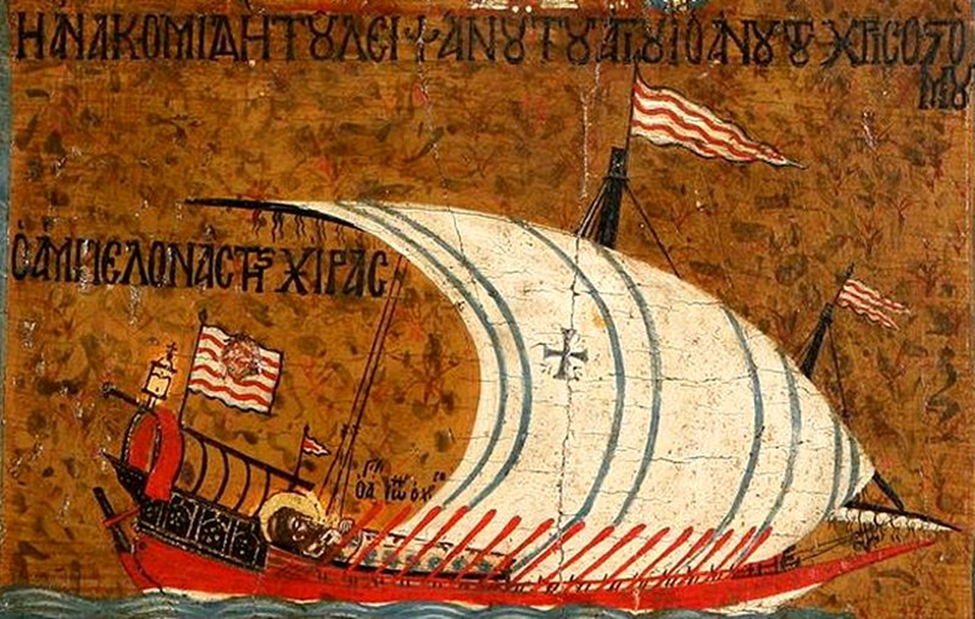
This chapter compares and contrasts the two medieval and renaissance watercraft types in the Mediterranean considering their functions, navigation, and more. I also added about 60 notes and two illustrations:


The first is a fourteenth-century lateen-rigged Byzantine galley, whereas the second is a ninth-century Byzantine ship sporting a settee sail. 

The paper needs time to "dry up". It might endure some further corrections and require a fresh look. Meanwhile, I have started collecting material for the second chapter. It will focus on warships and comprise several parts. For example, the development of gunpowder ordnance on board. 

Saturday, February 19, 2022

The Galleys vs. the Round Ship (1)

 The maiden chapter of a new project is nearly over. I will carry out the content editing at a later stage. Yet, I need to review the vocabulary section created for the extract to fish for novel ideas. 

The chapter gives a general idea of medieval shipping in the Mediterranean by depicting two broad types of watercraft. Even at this initial stage, I make use of contemporary travelogues written mostly by landlubbers. Besides galleys and round ships, I will speak about the main developments in the construction of ships and the sailors' diet. 

In the coming week, I am planning to revise an old article, The Ten Tribes and Other Monsters, from Unit IV of my second project, "The Enchanting Encounter with the East". Authorhouse UK is preparing this manuscript for publication. I wrote a few more letters asking for reusing of photos as book illustrations but meanwhile received only three positive replies. I hope that in some other cases the images do not require copyright permission; most of the pictures belong to the Middle Ages and have far exceeded a common requirement: the author's life plus a hundred years. 

From time to time, I make minor encroachments of my Ancient Mesopotamia project, which was covered by my first book, "Dawn and Sunset: A Tale of the Oldest Cities in the Near East". I am seeking a novel approach to this theme. Recently, I tried to figure out the main environmental differences between Upper and Lower Mesopotamia but failed. The paleoclimate is a tough thing to swallow; there are so many uncertainties and the picture appears too patchy to write a story. Most scholars speak about opposing contours, i.e. highlands vs. lowlands, and different trends in agriculture: rain-fed vs. irrigational farming. 

Today, I've had another idea. Maybe, I need to explore the structure of the early cities in Greater Mesopotamia. In my first book, I almost subscribed to Childe's definition of the ancient city; however, I came up with twelve points instead of ten and excluded such items as the area size and population figures. I will flesh out the details some other day. 

I would like to check a few hypotheses. 

1) Early cities had developed from pre-urban towns and villages.

2) Were such settlements as Jericho, Cayonu, and Catalhoyuk cities?

3) Did full-time craftsmen engage in pre-urban towns and villages?


Thursday, February 10, 2022

The Enchanting Encounter with the East: the book cover

 The artist sent me his proposal for the book cover. Though I cannot copy it, I will give you the general idea. There are two photos: a man climbing a steep mountain slope and another one walking along a suspension bridge. Both shots are taken in the backdrop of a "wild" environment.  

I continue to write letters to the owners of the images asking for permission to use them as the book illustrations. Until now, I have received three of them: from the British Library for the Psalter Mappa Mundi, from the University of Glasgow Library for an image from Vox Clamantis of John Gower, and from the Antiquarian Booksellers Association of America for Henrich Bunting's map of the world as a cloverleaf. 

In several cases, I was unable to find the owner. I still don't quite understand the meaning of these inquiries that I had to write at the insistence of the publishing house. In most cases, the copyright expires after 70 years. All my images have far exceeded this time frame. 

Another matter. I have made great progress with a draft of my new project. The first part of chapter 1 is nearly ready. It provides an outline of galleys and medieval shipping in the Mediterranean. I have also prepared bits and pieces for reconsideration concerning other parts. Chapter 1 will comprise five parts and summing up. As usual, it will have a lot of notes and some images. 

I will copy a few extracts in this blog but will not upload the rest on my website https://independent.academia.edu/BaizermanMichael

until the beginning of 2023. The content needs to "dry up" for some time to allow me a critical perspective. Another reason is that I need to upload many chapters from my second book before I move forward. 


Friday, February 4, 2022

The Enchanting Encounter with the East: A New Book

 Authorhouse UK, the self-publishing company that printed my first book, "Dawn and Sunset: A Tale of the Oldest Cities in the Near East", has offered to issue my second volume. Heaven knows, I did a lot to avoid this chance.

Meanwhile, I have found no traditional publisher that is enthusiastic about bringing out my composition. Since I had no alternative, I finally agreed. 

I did my best, revising the entire text again. I added several images though I am not sure that they will accompany the text. My literary consultant said that I need to ask permission from the owners of the photos even though most of my artwork is borrowed from  Wikipedia. I wrote several letters but received only one permission, from the British Library concerning the Psalter Mappa Mundi, where Jesus blesses the earth. 

In the following weeks, you will catch a glimpse of my second book.

It is titled, "The Enchanting Encounter with the East: Breaking the Ice between the Latin West and the Far East". I have uploaded more than half of the volume on the Academia site, https://independent.academia.edu/BaizermanMichael

Since nobody knows the exact order of the chapters, I will present the content here. The book comprises 29 chapters arrayed in six units. 

Unit I: THE MIRACULOUS REVIVAL OR THE PAINFUL RECOVERY

1: What If the Earth is the Sphere

2: How to Measure the Earth's Circumference

3: How Long Spans the Inhabited World

Bottom Line


Unit II:  The Saga of All My Sons

4. The Trefoil of the World

5. Where is the Heart of the World: The Location of Jerusalem on European Mind Maps

6. In Black and White: Racial Prejudices in the European Middle Ages

7. The Enigma of the Antipodes

Bottom Line 


Unit III: Unveiling the Alien

8. The Squall from the East

9. The Suspension Bridge across the Abyss

10. The Swan Song of the Mongol Thrust

Bottom Line


Unit IV: Mapping Marvels and Monsters: In the Shadow of the Iron Gate

11.     Meet your Enemy

12.     Alexander at the Caspian Gates

13.     Beware of Barbarians

14.     A Kernel of Truth

15.     Alexander Versus Gog-Magog

16.     The Lost and Found Tribes

17.     The Ten Tribes and Other Monsters

18.     The Turks in Jacob’s Tents 

Bottom Line


Unit V: Dreams Amid Debris: In the Shoes of Prester John

Prologue

19.     The Early Encounters: Under the Historic Radar

20.     The Shadow Crusader: Otto of Freising                

21.     The Black Prince: Yelu Dashi

22.     The Mysterious Letter

23.     Waiting for the Train that Would Never Come:  The Fifth Crusade 

24.     The Scourge of God: Chinggis Khan

25.     The Underdog and the Power Strife on the Steppes

Bottom Line


Unit VI: The Witness in the Den

26.     Barefooted Envoys

27.     John of Plano Carpini

28.     William of Rubruck   

29.     John of Montecorvino   

Bottom Line

List of Illustrations

Personal and Geographic Index

Further Reading