Saturday, November 12, 2016

The English Bowmen

The English were not necessarily the best bowmen in the Middle Ages though both the habit and the law demanded that able-bodied men of all walks of life should have practiced archery
on Sundays and holidays.

The English kings often hired Welsh and French archers to serve in their armies. These bowmen served as levies or contractors. The latter were often semi-professional troops who lived on the lands controlled by noblemen or the crown. They were employed in the wars overseas.

The system of low wages and irregular payments was counterbalanced by such "bonuses" as plunder and ransom. The transfer of a VIP prisoner demanded a circle negotiations; the warrior's captain, the superior commander and even the king were involved. The main sum was fairly paid for the captor.

There were no training camps for the warriors to practice archery, just holiday recreation and hunting trips. Bowmen was a privileged business and the kings were responsible for their armory and weapons. They wore helmets and had their body protected. This equipment was kept in stock to be handed in time of need.

The English longbow used in military context was standard and mass-produced. It could be crafted from a single piece of wood within a couple of hours. It stretched at 1.85 m in length and was able to strike at 250-330 m (though each researcher sticks to different values) according to modern reconstructions which enables it to rival with the Mongol composite bow.

At the end of a battle, a cry of havoc signaled the close of hostilities and the outset of plundering. However, a premature, unsanctioned call might spell a death penalty as it could throw the battle formation into confusion.
See more details  http://www.realmofhistory.com/2016/05/03/10-interesting-facts-english-longbowman/

תוצאת תמונה עבור ‪english bowman images‬‏


Friday, November 11, 2016

William of Rubruck - a draft copy

The second chapter in my current research is devoted to William of Rubruck who was sent by the French king to Sartack Khan to check up on rumors of his baptism and give spiritual aid to certain German slaves captured by the Tartars. The traveler reached the khan but made sure that the steppe notable stuck to his nomadic traditional values. William had never seen the prisoners.

However, the Mongol chiefs were indecisive what to do with this weird monk and he eventually made his way to the court of the Great Khan Mongke and visited his capital city Karakorum.

His account presents a wide range of data which I classified into a few topics: Appearance, Dwellings, Religion, etc. I find that William was neither an ambassador nor a missionary but rather a spy. The Mongol leaders probably understood this and wanted to manipulate him to serve their own interests.

Now, when a draft copy is over, I will study materials connected to the life of a great missionary, John of Montecorvino, who was sent as a papal legate on the Eastern mission and stayed in China for the rest of his life, founding the first Roman Catholic agency there.

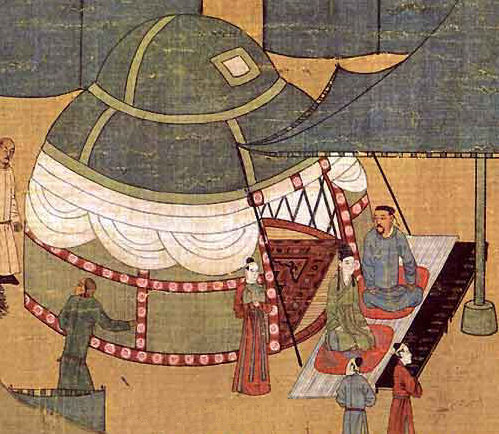
mongolian yurt khitan royal stork lady wen chi

The Great Khan and his first lady sitting at the entrance to their ger 
https://threegoldbees.com/other-articles/rubruck-mongols/

Saturday, November 5, 2016

William of Rubruck

My second champion is a Franciscan friar William (Guilliom) of Rubruck who insists on taking a missionary trip into the heart of the Mongol Empire.

Unlike his repeated denouncements of the association with Louis IX of France, our monk seems to be one of the royal associates. He counts the king as one of his spiritual friends. He transmits the royal letter to Sartak Khan and agrees to pass the Great Khan's missive to his royal patron.

On the other hand, Guillom is utterly unprepared to be a missionary. He is unaware of local languages and customs. He took with him an incompetent interpreter who cannot support most of spiritual dialogues but clings to bottle on every feast. He is too critical of other faiths-not exactly a kind of conversationalist you would like to have at your dinner table.

William probably acts as a royal spy disguised as a missionary. Anyway, his description of the Great Khan's entourage and the capital city Karakorum cast light on political developments within the Mongol Empire at its climax.
Erdene Monastery, Karakorum, Mongolia

http://www.wanderlust.co.uk/mywanderlust/members/worldsnapper/photos/mongolia_18219/70638

Saturday, October 29, 2016

End-October Update
I am through with the second leg of my FutureLearn course called "Radical Spirituality: The Early History of the Quakers". This is my third history course. Though this learning highway is not designed for professionals it transmits professional info and enables interesting discussions. I am not contented with writing my personal response and not always I have something ready. However, while looking through other replies, I can come up with an original approach. 

Before that, I finished a course, Archaeology of Portus: Exploring the Lost Harbor of Ancient Rome. These tracks are not necessarily linked to my own research but they give me an outlook of the work of historians, a glimpse of a bunch of exact sciences borrowed to pinpoint certain issues, and a chance to confront with the mainstream theories. 

I have reread the account of William of Rubruck and picked up a slew of citations which I need to lace together to finish up a draft of a current chapter. This will be chapter 2 in the last unit of my history book, The Enchanting Encounter with the East. The unit is devoted to the experience of western legates and missionaries sent to the Far East to spread the message of Roman Catholism and to spy the activities of the Mongols. The research is in full swing. My full list includes 14 names but can be cut down to 9 or even less. My next author will be John of Montecorvino, the head of the first Catholic mission to China. 

Thursday, October 6, 2016

US Reviews

US Reviews published a very favorable review of my book, Dawn and Sunset.
Dawn and Sunset: A Tale of the Oldest Cities in the Near East 
Michael Baizerman
AuthorHouseUK
HISTORY
978-1-5049-3611-8 Four Stars (out of Five)
Dawn and Sunset is a well researched, nicely written, organized account of early Mesopotamian history.
Some of the world’s first cities emerge, prosper, and decline over the course of several millennia while their citizens chart remarkable advances in art, linguistics, religion, politics, warfare, and other areas. Michael Baizerman explores these developments in Dawn and Sunset: A Tale of the Oldest Cities in the Near East, a scholarly look at the history of ancient Mesopotamia.
Baizerman begins with a brief explanation of the region’s history and geography, and an outline of its different historic periods. He argues that the twelve things required for a settlement to be considered urban were all present in Mesopotamian cities. These include a dedicated religious site for worship and festivals; a temple social hierarchy with priests, administrators, worshipers, and slaves; industrial, commercial, scientific, and cultural centers; a system of record-keeping; a legal center with courts and laws; a centralized government; a military; a “melting pot” of different ethnicities; and a welfare safety net.
A series of sections in the book individually delve into Mesopotamian advances in the areas of writing, agriculture, foreign trade, laws, and warfare. The development of sailing boats, the pottery wheel, the use of irrigation, wheeled carts, kiln-fired bricks, and writing instruments all underscore the region’s growing sophistication.
Dawn and Sunset is a good, fundamental summation of Baizerman’s long-time academic focus. The book contains a wealth of information. However, much of the in-depth research was done on the Internet, and Internet sources are heavily cited. More print sources might have extended the book’s usefulness for students and other scholars, as web-based sources can be fleeting.

Saturday, October 1, 2016

New Developments October 2

Not much is going on. I'm still collecting material for a new chapter about William of Rubruck. I have to describe the Mongol society as this traveler witnessed.

My page on Scriggler has reached over 12 K readers. My platform is growing in spite of the fact that I don't publish new articles. My publisher advised me not to upload the whole book on the web. You can read about nine chapters at
 https://scriggler.com/Profile/michael_baizerman
If I write some notes on other topics, I will add them to my list.

I finished the fourth leg of FutureLearn course "The Archeology of Portus". Week 4 was devoted to the development of the port in the III-IV centuries AD. In 337 AD it became a town. We explored Building 5 which is supposed to be a ship shed measuring 240 m in length and 18 m in height. It had 12 bays for ships of various widths, from 4.5 m to 20 m. The researchers are sure that its initial function was to repair and build ships. The ship shed opens both on the Claudian and Trajan basins. We also studied a copper coin minted during the tenure of Emperor Constantine during the 320s-330s AD. We understood how much info can be obtained from the image and recording on the coin and that part of this data can be restored from special digital photography.

I am still confused about scientific methods used in archaeology but they add a lot to understanding of the past events.
תוצאת תמונה עבור ‪portus images‬‏

Friday, September 16, 2016

Dawn and Sunset: New Developments


There are two pieces of news concerning my history book, Dawn and Sunset, that I'd like to share with you.

My book entered the contest, Eric Hoffer Book Award, for independent books. The results will be published in May, 2017. It's a great honor. The book was nominated by my publishing house, Authorhouse UK.

Pacific Book Review published a review of my book and I could not expect anything better. Here is the text. 

Author: Michael Baizerman
Publisher: AuthorHouseUK
ISBN: 9781504936118
Pages: 289
Genre: Education
Reviewed by: S. Marie Vernon
Rating: 4 Star Review
Pacific Book Review
Dawn and Sunset is a compelling Tale of the Oldest Cities of the Near East written by
amateur historian and Israeli high school English teacher, Michael Baizerman. It’s
clear, Baizerman has spent countless hours researching and documenting this work.
He has compiled minute details of everyday life of the inhabitants of the old world
known as Mesopotamia and the cradle of civilization. The oldest cities encompassed
the Persian Gulf area and were referred to as Sumerian, Akkadian, Babylonian and
Assyrian regions. The Mesopotamia area today is known as Eastern Turkey, IRAQ,
Kuwait, Baghdad, Iran and Northern Syria. The Greek meaning of Mesopotamia is,
land between two rivers.” The twin rivers, the Tigris and Euphrates nourished
Mesopotamia and made it possible for nomadic tribes to begin to cultivate the land for
agriculture and eventually settle into communal villages where life as we know it began.
Then much changed over the course of time. A lot of historical ground is covered in the
many millenniums referenced with some emphasis on the third and fourth millennia
BCE.
This work may be more than A Tale, perhaps it’s a social study of our earliest
ancestors? Perhaps it’s closer to a documentary of facts, yet facts that are sometimes
verified through myths, legends and the poetry of that millennium? Baizerman blazes
on undaunted by the scarcity of information for some periods and events. He gathers
his content from different angles to expose discrepancies and biases for what they
were. If there is no documentation to support the claim he will pursue other avenues;
he will find a hieroglyphic, a poem or an architectural marker of that time period so his
points are well documented. The author himself says it best, “Only artists and scholars
are entitled to examine our history through a magnifying glass with inexhaustible vigor,”
which he does very well in creating this educational volume called Dawn and Sunset.
The Gods drove every decision in the ancient world. Temples attested to their glory and
power. In the beginning, the Temples controlled the economic life of a community.
They were central to all the regions and the many Gods were worshipped and honored
constantly. Life was a battle, a consistent struggle with the hostile land and various
populations of people. Irrigation and farming allowed for communal villages to give way
to more complex societies with district states. Then pristine cities became early
empires and these gave way to dynasties with corruption and exploitation that would
bring in the Dark Ages and the eventual collapse of this early civilization that had been
Two thousand turbulent years in the making.” The temples fell to government rule and
general’s built extravagant palaces to display power and demand respect whether they
deserved it or not. Many great leaders and warriors would rise and fall. Some were
virtuous and some were not. War was inevitable and peace was all but nonexistent.
Through it all, writing, language and technological advancement prevailed; metals,
ceramics and new building materials enhanced and changed their way of life forever.
New transportation routes and foreign trade changed the landscape, social classes, and
the expectations of the people. Division of labor and other inequities emerged that
would lead to more wars and the eventual demise of a once glorious nation known as
Mesopotamia. From pre-civilization to civilization to its very downfall, this book delivers
a lot as each chapter is organized and packed with great detail about the grueling and
difficult historical times between the Dawn and Sunset of Mesopotamia– A Tale of the
Oldest Cities of the Near East. Ironically, through this writing we can see many parallels
of modern day society as it faces some of the same indignities and dilemmas of this
historical period.
After Dawn and Sunset author Michael Baizerman emerges with a new book and is
already writing it. It’s about the attitude of the Latin West to the East on the eve of the
Age of Discovery. Both books should appeal to history lovers and educators who like a
dedicated spirit of inquiry and documented exposure of facts that may not be so factual.
Of course, any differences in opinion, by this author is well researched, well
documented and well written. These volumes are sure to be a handy resource for any
educator who would like that little extra detail when it comes to the history of ancient
civilizations.