Saturday, February 4, 2017

Writing a book

I'd like to thank all my readers who give me the greatest respect that a writer deserves: to learn his opinion. More than one hundred readers perused my blog last month and my total auditorium has exceeded 500.

I'm happy to inform you that I have completed my long-term historic research on the conception of the East on the Latin West throughout the Late Middle Ages. The study has been conducted for six or seven years and its results contain the manuscript which includes dozens of articles.

At the current stage, I have started converting the manuscript into my second book. This is time to remind that my first book, Dawn and Sunset: A Tale of the Oldest Cities in the Near East, was published in 2015 as a second edition. It tells the story of the earliest urban communities on earth that mushroomed in Mesopotamia in the course of the fourth and the third millennia BCE. You may view seven chapters of this book on my Author's Page at scriggler.com
https://scriggler.com/Profile/michael_baizerman

The working title of my second book is

The Enchanting Encounter with the East:

Breaking the Medieval Ice between Latin Europeans and the World beyond Islam 

I have managed to edit the chapter titled ,What If the Earth Is the Sphere? In this chapter the reader learns that all European well-educated people conceived the Earth as an immobile globe, visualizing it in different shapes. I upload an extract from this chapter:

“Thus when the God, whatever God was he,
Had form’d the whole and made the parts agree,
That no unequal portions might be found,
He moulded Earth into a spacious round."
-Ovid, Metamorphoses (1)

"Of what importance is it to know whether the Earth is a sphere, a cylinder, a disk, or a concave surface?"  -Basil of Caesarea (2)
 
The term “geography” would fall out of use among medieval European scholars. This subject never pertained to the canon of “liberal arts” worthy to become part and parcel of the university curriculum. The western literati would not recognize the “earth description” in its own terms, treating it as a handmaid of Cosmography at best or as a concubine of Theology at worst.

Geographic ideas that held and refined medieval intellectuals originated in Ancient Greece. By adhering to these old-fashioned and partly erroneous tenets, western academics followed the path of “universal wisdom”, pouring the old wine into new wineskins.

In compliance with their classical mentors, Latin disciples unanimously adopted the image of the spherical Earth. They perceived our planet as a tiny anchored eyeball inside an enormous socket of the heaven; the globe surrounded by a number of concentric circles-the orbits of the revolving planets.

The geocentric vision of cosmographers placed the immobile Earth at the heart of the universe whose rotating celestial spheres (3) were spinning around non-stop, endowing the “Blue Marble” with an ability of constant innovation and improvement. This stationary center was protected by concentric circles of water, air, and fire.

In a renowned illustration to a Latin poem, Vox Clamantis ("The voice of the one crying out"), its author, John Gower, is shown shooting arrows at the sinful world. The poet blasts humankind for their wickedness at the backdrop of the Earth fashioned as a sphere with compartments for air, earth, and water. 
  
Image 1: The author as a shooter raining his satirical arrows on the wicked and sparing the righteous (4) 
                This image of the spherical Earth would not surprise an “extraterrestrial” onlooker, for whom the convexity of our planet was an undeniable fact. However, all human observers were “insiders” and based their assumptions on circumstantial evidence such as… 

Friday, January 20, 2017

Montecorvino (3)

The good news is that I have completed the draft copy of the chapter about the experience of Montecorvino. I have also realized that it will be my last chapter in this unit as well as in the  entire manuscript. 
While collecting data for this unit, I decided to include genuine travelers who described their own experience with the Far East. I was also interested in people who knew how to tell fact from fiction. My initial list included about 15 names but only three of them meet my criteria: Plano Carpini, William of Rubruck, and John of Montecorvino. I also pondered on John of Marignolli, Odoric of Pordenone, and Jordanus de Severac. However, in spite of their long stay in India, China, or South-Eastern Asia, their writings abound with the "received wisdom" of authors who had never visited these places. 
I would like you to read an additional extract from my last chapter which tells about the Onggut prince who assisted John in his first steps on the Chinese soil.  

"On the way to Khanbalik, the papal legate managed to convert a real prince. The scion from the Onggut ruling house and the son-in-law of the Great Khan, Kuolijisi received baptism, picking up the Christian name George. Born in the “Nestorian” persuasion, like many of his countrymen, this high-profile disciple resolved to cross the lines after the encounter with a gifted preacher.  
To give a personal example to his subjects, Prince George took minor orders which enabled him to assist Montecorvino in celebrating the Mass. To draw more supporters to his new faith, the provincial ruler built a house of worship named the “Roman church”, the maiden Catholic edifice on the Chinese soil. When our friar had to leave for Khanbalik, the beloved disciple gave him a lavish grant to pursue his mission. The potentate even called his son Shu’an [Chinese for “John”] in the memory of his spiritual friend.
The contemporary Chinese sources, who know George as Kuolijisi, Prince of Gaotang, are mum concerning his devotion to Christianity. They depict him within a framework of the Onggut chief and a Chinese intellectual. Well-versed in Confucian studies, he collected a mammoth library containing thousands of manuscripts at his residence, and entertained his court, leading conversations with distinguished scholars. He used to talk with court philosophers about the whole range of cosmological subjects, including yin-yang teaching, astrology, numerology, and zodiac signs.
It might be that Prince George served the two masters, finding no contradiction in the blend of the Confucian philosophy and the Roman Catholicism. The latter would introduce him to universal values while the former would bind him to the native land.

The allegiance of the Onnguts to Rome was short-lived and didn’t outlast Prince George’s death. During the reign of his brother, most of the adepts returned to their mother Church. 


Friday, January 6, 2017

John of Montecorvino (2)

Having finished collecting the data about the first Catholic archbishop of Beijing, I started to write the first draft of the chapter. This is going to be the third chapter of the last unit of my manuscript. The following extract explains the shift in the task laid on western travelers eastward, from reconnaissance to missionary work.

 Toward the end of the thirteenth century, the leading powers of the world realized that the East Asia was going to be their next playground. The Lord Pope, not intending to fall behind, made up his mind to spread his reconnaissance network to cover this novel venue.
His choice fell on a forty-two-year-old friar priest with ample diplomatic experience and close familiarity with the Middle Eastern politics. John of Montecorvino had been involved in negotiations for the reunion of Constantinople with Rome and was well connected to the courts of the Il-Khan of Persia and the king of Armenia.
John set off in a disguise as a missionary to sow the word of God among the heathens of India and China. To make his mission a success, the Franciscan friar had to reach the court of the Great Khan in Khanbalik (Beijing) and convert him to Christianity. Did the Pope truly believe that it was possible?
Since the ongoing hostilities choke the land road via the Caspian Sea and the Central Asia, the papal legate opted for a marital route, embarking in Hormus, a port on the Persian Gulf, on a dhow bound for southern India.  This ocean-going vessel made of sewn plunks with a double-ended hull, a lateen sail, and a pair of steering oars at the stern was designed to deliver pearls and Arab horses to foreign harbors. Taking advantage of monsoon winds, it would sail overseas in winter and made a return trip in summer.
The ocean passage was hazardous. Our passenger, who was used to relatively safe travel across the Mediterranean, put no trust in local boats which were “sewn like clothes with twine” and liable to leaks. They seemed utterly unsuitable for a deep-water voyage, being “mighty frail and uncouth” and lacking iron nails and caulking. Their only sail, made of “matting or some miserable cloth”, fluttered in the breeze like a miserable butterfly. Off the Malabar Coast they were in constant danger of running aground against countless reefs and shoals. [Henry Yule, (ed.) Cathay and the Way Thither, vol. iii. (New Delhi: Asia Educational Services, 2005), 66-67.
While watching the nocturnal sky, the traveler was puzzled by another peculiarity: the Polar Star lay unexpectedly low, suggesting the proximity to the equator.  [Ibid, 60] 


A dhow in the Indian Ocean 
https://en.wikipedia.org/wiki/Dhow#/media/File:Dhow_znz.jpg

Friday, December 2, 2016

John of Montecorvino

My new chapter will be devoted to John of Montecorvino, a Franciscan friar who reached China at the end of the 13th century. His letters focus on his missionary activities. He established two episcopal sees and rendered spiritual service for those in need.

I have copied a few facts, read his letters, and am now processing notes about this person and the milestones of his life.

We enter the period when the united Mongol Empire was split into four polities whose rules had to give up the demand for the world domination. The advance to the Western Europe as well as the incursion into Japan failed to materialize.

The Apostolic See with the aid of newly-created orders of mendicant friars resumed its die-hard policy of spreading the word of God among diverse nations. One of the missionaries called to the banner was an Italian priest-monk Giovanni of Montecorvino.

The Franciscan friar gained immense diplomatic experience. He was involved into negotiations between the Latin and Greek Churches about the issue of reunion. He was the man to approach the king of Armenia and the Ill-Khan of Persia who used his links with the Roman curia to pass their missives.

John's ability to get along with the representatives of sundry cultures and pick up eastern languages - a rare gift among Italian missionaries - made him an ultimate candidate to a new mission to the fringes of the known world.


John of Montecorvino on a windy path to a spiritual perfection
http://www.bdcconline.net/en/stories/img/storypics/portraits/MontecorvinoJohannes.jpg


Saturday, November 12, 2016

The English Bowmen

The English were not necessarily the best bowmen in the Middle Ages though both the habit and the law demanded that able-bodied men of all walks of life should have practiced archery
on Sundays and holidays.

The English kings often hired Welsh and French archers to serve in their armies. These bowmen served as levies or contractors. The latter were often semi-professional troops who lived on the lands controlled by noblemen or the crown. They were employed in the wars overseas.

The system of low wages and irregular payments was counterbalanced by such "bonuses" as plunder and ransom. The transfer of a VIP prisoner demanded a circle negotiations; the warrior's captain, the superior commander and even the king were involved. The main sum was fairly paid for the captor.

There were no training camps for the warriors to practice archery, just holiday recreation and hunting trips. Bowmen was a privileged business and the kings were responsible for their armory and weapons. They wore helmets and had their body protected. This equipment was kept in stock to be handed in time of need.

The English longbow used in military context was standard and mass-produced. It could be crafted from a single piece of wood within a couple of hours. It stretched at 1.85 m in length and was able to strike at 250-330 m (though each researcher sticks to different values) according to modern reconstructions which enables it to rival with the Mongol composite bow.

At the end of a battle, a cry of havoc signaled the close of hostilities and the outset of plundering. However, a premature, unsanctioned call might spell a death penalty as it could throw the battle formation into confusion.
See more details  http://www.realmofhistory.com/2016/05/03/10-interesting-facts-english-longbowman/

תוצאת תמונה עבור ‪english bowman images‬‏


Friday, November 11, 2016

William of Rubruck - a draft copy

The second chapter in my current research is devoted to William of Rubruck who was sent by the French king to Sartack Khan to check up on rumors of his baptism and give spiritual aid to certain German slaves captured by the Tartars. The traveler reached the khan but made sure that the steppe notable stuck to his nomadic traditional values. William had never seen the prisoners.

However, the Mongol chiefs were indecisive what to do with this weird monk and he eventually made his way to the court of the Great Khan Mongke and visited his capital city Karakorum.

His account presents a wide range of data which I classified into a few topics: Appearance, Dwellings, Religion, etc. I find that William was neither an ambassador nor a missionary but rather a spy. The Mongol leaders probably understood this and wanted to manipulate him to serve their own interests.

Now, when a draft copy is over, I will study materials connected to the life of a great missionary, John of Montecorvino, who was sent as a papal legate on the Eastern mission and stayed in China for the rest of his life, founding the first Roman Catholic agency there.

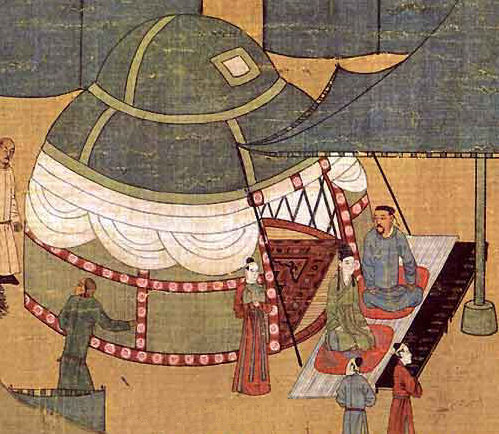
mongolian yurt khitan royal stork lady wen chi

The Great Khan and his first lady sitting at the entrance to their ger 
https://threegoldbees.com/other-articles/rubruck-mongols/

Saturday, November 5, 2016

William of Rubruck

My second champion is a Franciscan friar William (Guilliom) of Rubruck who insists on taking a missionary trip into the heart of the Mongol Empire.

Unlike his repeated denouncements of the association with Louis IX of France, our monk seems to be one of the royal associates. He counts the king as one of his spiritual friends. He transmits the royal letter to Sartak Khan and agrees to pass the Great Khan's missive to his royal patron.

On the other hand, Guillom is utterly unprepared to be a missionary. He is unaware of local languages and customs. He took with him an incompetent interpreter who cannot support most of spiritual dialogues but clings to bottle on every feast. He is too critical of other faiths-not exactly a kind of conversationalist you would like to have at your dinner table.

William probably acts as a royal spy disguised as a missionary. Anyway, his description of the Great Khan's entourage and the capital city Karakorum cast light on political developments within the Mongol Empire at its climax.
Erdene Monastery, Karakorum, Mongolia

http://www.wanderlust.co.uk/mywanderlust/members/worldsnapper/photos/mongolia_18219/70638